The Efficiency Era: How OpenAI's GPT-5.6 and GPT-Realtime Are Transforming Retail and Workflows
overloaded AI 的 AI API 使用建议
overloaded AI 面向需要 OpenAI 兼容接口、Claude/Gemini/GPT 多模型切换、包月额度管理和图像模型调用的用户。阅读本文后,可以结合本站的模型清单、独立使用文档和个人面板,把教程内容直接落到实际调用流程中。
As artificial intelligence scales globally, the tech landscape is undergoing a critical transition. AI is moving beyond simple proof-of-concept chatbots to deeply integrated, highly efficient agents capable of driving real business value.
To power this transition, OpenAI recently introduced the GPT-5.6 model family, designed to optimize capability and cost across various tasks. In parallel, forward-thinking startups like avatarin are leveraging OpenAI's real-time capabilities to deploy advanced, multilingual shopping agents for retail giants like Yamada Denki. Together, these developments mark the beginning of an "interface revolution" in both backend developer workflows and consumer-facing retail experiences.
The Next Frontier: GPT-5.6 Fuses Intelligence with Efficiency
For enterprise AI to become truly ubiquitous, the industry must solve a fundamental equation: delivering more intelligence per dollar. OpenAI’s GPT-5.6 model family addresses this by optimizing every layer of the technology stack, dividing workloads across three specialized models:
- GPT-5.6 Sol: The flagship reasoning model. It outperforms Claude Fable 5 on the Artificial Analysis Coding Agent Index at less than half the cost.
- Terra: Delivers the high intelligence benchmarks of previous frontier models like GPT-5.5 at half the price.
- Luna: The fastest and most affordable model in the family, priced 80% lower than Sol.
Optimizing Inference Autonomously
To achieve these cost reductions, OpenAI applied an interesting strategy: using GPT-5.6 Sol to optimize its own architecture and execution environment. Working within OpenAI's Codex system, Sol autonomously analyzed production traffic, redesigned speculative decoding pipelines, and even rewrote GPU-level Triton and Gluon kernels. This self-optimization cycle successfully reduced end-to-end serving costs by 20% and boosted token-generation efficiency by 15%.
Streamlining the Agentic Harness
Beyond raw inference, how models interact with tools and maintain context dictates their real-world speed and cost. OpenAI's Rust-based agentic harness implements specific strategies to avoid "context bloat":
- Deferred Discovery: MCP tools and plugins are only surfaced when the model actually needs them, keeping the context window clean.
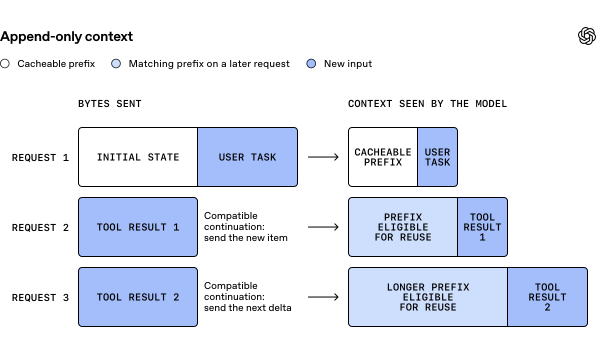
- Append-Only Contexts: To maximize prompt caching, the harness treats history as append-only. Instead of injecting runtime updates or changing tool lists dynamically, new information is strictly appended. This ensures the GPU can reuse precomputed prompt prefixes.
From Code to Storefront: avatarin's GPT-Realtime Retail Agent
These massive backend efficiencies pave the way for complex, low-latency applications that interact directly with the public. A prime example is avatarin, an AI customer service company spun out of ANA Holdings.
Partnering with Japan's major home-appliance retailer, Yamada Holdings, avatarin sought to address a persistent retail issue: providing expert customer service beyond standard store hours while managing tight staffing limits.
Using GPT-Realtime, they built the Kurashi-Marugoto AI Agent, a 24/7 shopping assistant designed to guide users from product discovery to purchase decisions via natural voice and text conversations.
The Architecture of a Retail Agent
Rather than relying on traditional chatbots that simply wait for matching keywords, avatarin designed a proactive, context-aware agent around three pillars:
- Retrieval-Augmented Generation (RAG): Keeps product recommendations and technical specifications accurate by grounding GPT-Realtime’s responses in Yamada Denki's live inventory and product databases.
- Expert Conversation Design: The agent adapts its questions based on the product category. For example, if a shopper is looking for a refrigerator, the agent knows to ask about family size and kitchen dimensions, naturally adjusting even if the user temporarily goes off-topic.
- Proactive Engagement: Traditional chatbots wait to be prompted. avatarin’s agent actively asks follow-up questions to uncover the customer's true pain points.
Traditional Chatbot: "Please enter a keyword to search for products."

GPT-Realtime Agent: "I can help you find a refrigerator. How many people are in your household, and do you have any specific space limitations in your kitchen?"
Proven Real-World Impact
During a two-week public campaign on Yamada Denki's e-commerce platform, the impact of this real-time agent was clear:
- 30,000 shoppers engaged with the agent.
- 92% of post-use survey responses were positive.
- Customers reported that the agent felt "easier to talk to than an actual sales associate," allowing them to candidly discuss budgets or uncertainties without sales pressure.
Furthermore, the system captured valuable business insights by analyzing why customers hesitated or what details influenced their purchase choices, revealing customer behaviors that standard online shopping carts fail to capture.

The Future: One Intelligence, One Brand
The success of both GPT-5.6's optimizations and avatarin's retail application points toward a unified future. avatarin envisions a world of "One Intelligence. One Brand. Every interface."
Instead of siloed applications for web, phone systems, and physical in-store kiosks, businesses will deploy a single, consistent intelligence. This agent will carry the customer's context across every channel, ensuring that a conversation started on a mobile phone can be seamlessly continued at an interactive kiosk in a physical retail store.
As general-purpose, multimodal AI continues to become faster and significantly cheaper, the focus shifts to how creatively businesses can deploy this intelligence. The era of single-purpose AI is ending, making way for unified, cost-effective, and highly conversational customer experiences.