The Hidden Infrastructure of AI: Why Environment Matters More Than Models
overloaded AI 的 AI API 使用建议
overloaded AI 面向需要 OpenAI 兼容接口、Claude/Gemini/GPT 多模型切换、包月额度管理和图像模型调用的用户。阅读本文后,可以结合本站的模型清单、独立使用文档和个人面板,把教程内容直接落到实际调用流程中。
For years, the narrative of Artificial Intelligence has been dominated by a single metric: model size. We assumed that bigger models with more parameters would naturally solve the most complex problems. However, a pair of groundbreaking research developments released in late July 2026 suggests a paradigm shift. Whether we are diagnosing brain tumors through longitudinal MRI or solving abstract reasoning puzzles, the performance of an AI is often limited by its environment—the data stratification protocols and the API harnesses—rather than the model's inherent intelligence.
The Crisis of 'Random Shuffling' in Medical Imaging
In the world of medical AI, reliability is a matter of life and death. Yet, a recent paper titled "Beyond Random Partitioning: Unsupervised Spatio-Temporal Stratification for Cohort Balancing in Longitudinal Medical Imaging" (arXiv:2608.00073) highlights a foundational flaw in how we train these systems.
Traditionally, researchers take a dataset and "naively shuffle" it into training, validation, and test sets. While this works for static images of cats and dogs, it fails spectacularly in longitudinal medical imaging. Real-world clinical cohorts are messy; they feature "heavy-tailed feature dispersion" and irregular sampling intervals where patients might visit a clinic twice in one month and then not again for a year.
The Tripartite Solution
To address this, researchers led by Qinghui Liu developed a Tripartite Dataset Analytics Framework. This system doesn't just shuffle data; it audits it across three dimensions:
- Spatial Grid Integrity: Ensuring the physical dimensions of the scans are consistent.
- Multi-Parametric Intensity Fingerprints: Analyzing the unique signal intensities of the imaging equipment.
- Longitudinal Temporal Trajectories: Mapping how a patient's condition evolves over time.

By moving away from random partitioning and using elbow-optimized K-means clustering, the researchers reduced cross-subset intensity bias from a staggering 34.1% to less than 2.1%. This ensures that when an AI is tested, it isn't being evaluated on "out-of-distribution" data that it never had a chance to understand during training.
Solving the ARC-AGI-3 Reasoning Puzzle
While medical researchers were fixing data splits, engineers at OpenAI were tackling a different kind of environmental problem. Despite the raw power of models like GPT-5.6 Sol, they initially struggled with the ARC-AGI-3 benchmark—a series of 2D puzzle games designed to measure how well AI learns and reasons in unfamiliar territory.
Initially, GPT-5.6 Sol scored a mere 7.8% on these puzzles. This led to a critical realization: the benchmark wasn't just measuring the model; it was measuring the "harness"—the API settings and the way the model interacts with the task.
The Power of Two Settings
OpenAI discovered that by enabling two specific settings in their Responses API—Retained Reasoning and Compaction—they could triple the model's scores.
- Retained Reasoning: In generic harnesses, a model's "private thoughts" (the reasoning steps it takes before an action) are often discarded between turns. This meant the model had to relearn the game rules every single time it made a move. By retaining these thoughts, the model could build a coherent strategy over time.
- Compaction: Traditional harnesses use "rolling truncation," where the oldest information is simply deleted when the context window is full. Compaction instead summarizes the history, preserving the core lessons learned during early stages of the task.
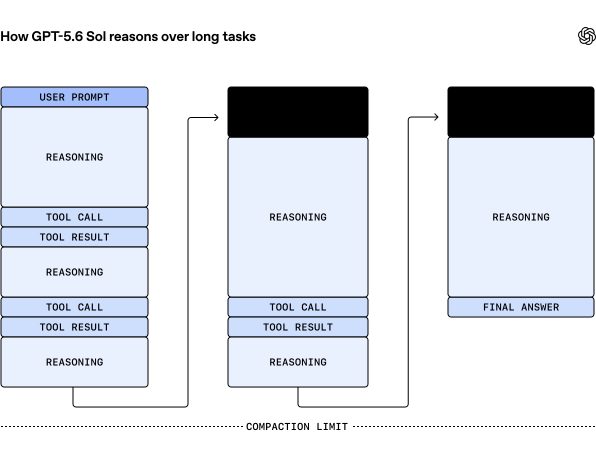
With these settings, GPT-5.6 Sol's score jumped from 13.3% to 38.3% on the public set, while using 6x fewer output tokens. It wasn't that the model became "smarter"; it was that the model was finally given the tools to use the intelligence it already possessed.
The Synthesis: Lessons for the Future of AI
These two disparate fields—medical imaging and AGI benchmarking—offer the same vital lesson: Context is King.
- For Medical Developers: The takeaway is that we must stop treating medical datasets like generic image banks. We need auditable, spatio-temporal Standard Operating Procedures (SOPs) to ensure our cohorts are balanced. Reliability comes from engineering the dataset as carefully as we engineer the neural network.
- For API Developers: The takeaway is that evaluation "harnesses" should match real-world use cases. If a model is going to be used in a complex, multi-turn environment like a coding assistant or a scientific researcher, evaluating it with a "clean slate" on every turn is not just unfair—it's inaccurate.
Conclusion
As we move toward the next generation of AI, the focus is shifting. We are moving beyond the era of "bigger models at any cost" and into the era of precision infrastructure. Whether it's the Tripartite Analytics Framework for MRIs or the Responses API for LLMs, the goal is the same: providing AI with a structured, consistent, and memory-capable environment where it can truly excel.

To maximize performance in your own AI workflows, consider moving away from generic, legacy APIs and "naive" data handling. The evidence is clear: the right settings and the right data stratification don't just improve performance—they can triple it.